Only 51 of the 210 most-recognizable Naruto characters, fewer than one in four, carry a kekkei genkai. And 17 of them share the same one. Bloodline limits feel omnipresent because the story's biggest players hoard them, but the full picture is a short, sharply clustered list. This page is that list: every kekkei genkai that appears across the 210-character Narutodle dataset, grouped into its three families, with mechanics, clan origins, and every user linked to their profile.
What is a kekkei genkai?
A kekkei genkai (血継限界, "bloodline limit") is an ability carried in the body itself and passed genetically, either a fusion of two chakra natures that ordinary training can never combine, or a physical trait like an eye or a skeleton that does something no normal body can. Because the ability lives in the wielder's DNA, it cannot be learned, taught, or copied, which is what separates it from the two things it is most often confused with:
The distinction has teeth in the story. Kakashi copied over a thousand jutsu with his Sharingan and never once reproduced a bloodline technique, because there is nothing to observe: the ability is the body. It also has teeth in the game, where hiden arts like the Nara clan's shadow manipulation are famous enough that players expect them in the kekkei genkai column and lose a guess when the cell comes back empty. If you remember one sentence from this page, make it this one: inherited in the blood means a kekkei genkai; guarded by a clan means hiden; banned by law means kinjutsu.
| Term | Bound to | Can others learn it? |
|---|---|---|
| Kekkei genkai | Bloodline (DNA) | No — inherited or transplanted only |
| Hiden | A clan's secrecy | In principle yes, but the clan guards it |
| Kinjutsu | Nothing — it is a legal status | Yes, which is why it is forbidden |
The three categories at a glance
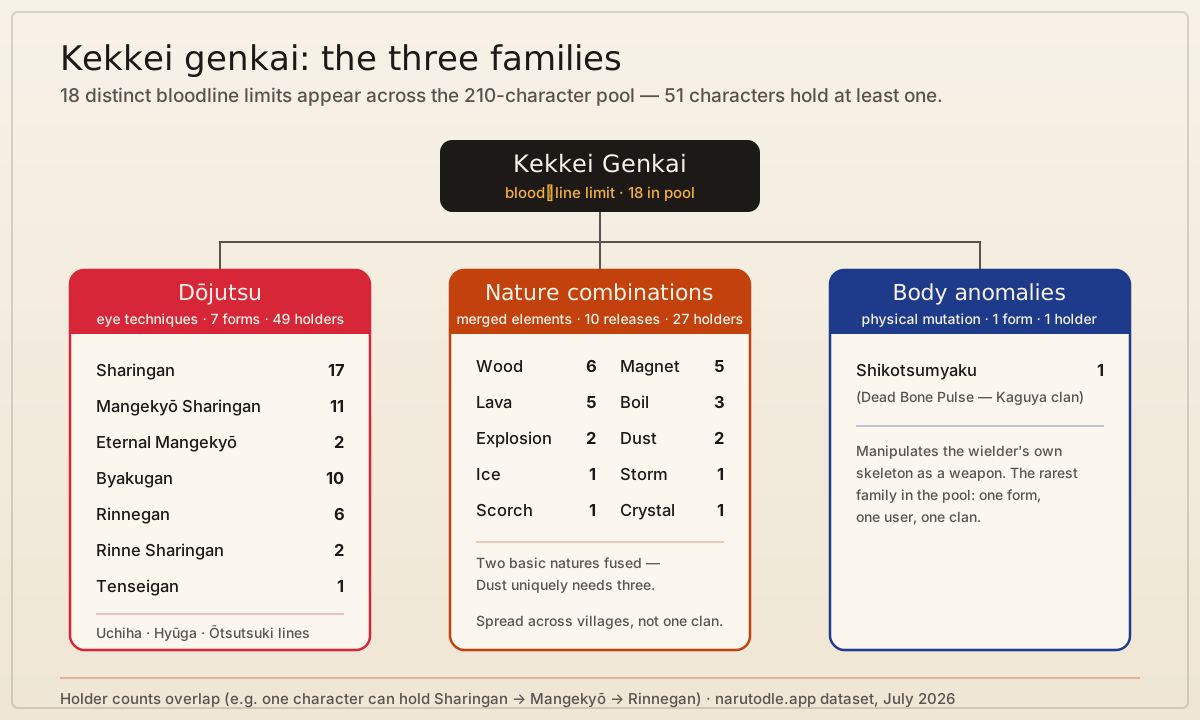
Every bloodline limit in the pool falls into one of three families: eye techniques, merged chakra natures, or body anomalies. The taxonomy below carries the exact counts; the master table that follows is the reference you came for.
| Kekkei genkai | Category | Clan / origin | Users in pool |
|---|---|---|---|
| Sharingan | Dōjutsu | Uchiha | 17 |
| Mangekyō Sharingan | Dōjutsu | Uchiha | 11 |
| Eternal Mangekyō | Dōjutsu | Uchiha | 2 |
| Byakugan | Dōjutsu | Hyūga / Ōtsutsuki | 10 |
| Rinnegan | Dōjutsu | Sage of Six Paths' lineage | 6 |
| Rinne Sharingan | Dōjutsu | Ōtsutsuki | 2 |
| Tenseigan | Dōjutsu | Hamura's line | 1 |
| Wood Release | Nature fusion | Hashirama (Senju) | 6 |
| Magnet Release | Nature fusion | Suna / Kumo lines | 5 |
| Lava Release | Nature fusion | Multiple villages | 5 |
| Boil Release | Nature fusion | Kiri lines | 3 |
| Explosion Release | Nature fusion | Iwa lines | 2 |
| Dust Release | Nature fusion | Tsuchikage lineage | 2 |
| Ice Release | Nature fusion | Yuki clan | 1 |
| Storm Release | Nature fusion | Kumo | 1 |
| Scorch Release | Nature fusion | Suna | 1 |
| Crystal Release | Nature fusion (anime) | Unknown | 1 |
| Shikotsumyaku | Body anomaly | Kaguya clan | 1 |
Category I — Dōjutsu (eye techniques)
The eye techniques are the franchise's aristocracy, and they are organized as ladders: each form is a gate to the next, paid for in trauma, transplants, or divine ancestry.
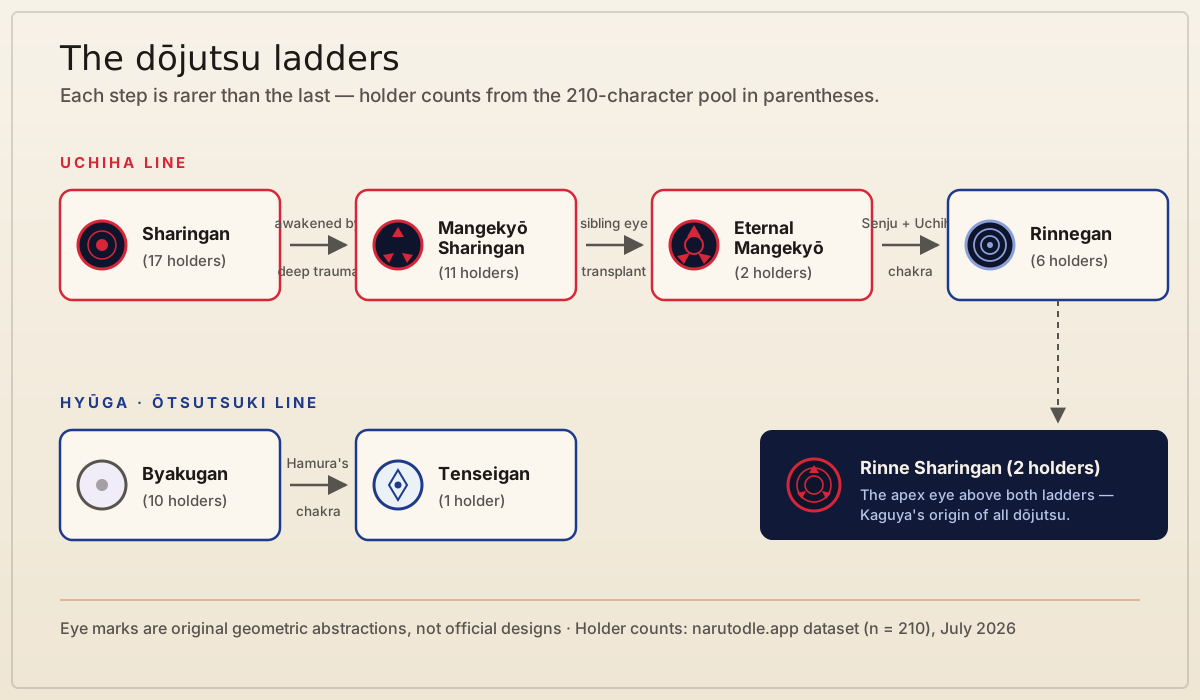
Sharingan → Mangekyō → Eternal Mangekyō (the Uchiha ladder)
The base Sharingan grants perception: it reads chakra, sees through genjutsu, predicts movement, and copies any non-bloodline technique it can watch. It is also the most common kekkei genkai in the pool at 17 users, which tells you how thoroughly the Uchiha dominate the story's cast sheet. The Mangekyō Sharingan awakens through the trauma of losing what you love most, and each pair manifests unique techniques: Amaterasu's unquenchable flame, Tsukuyomi's subjective-time genjutsu, Susanoo's armored colossus, Kamui's phasing. The price is progressive blindness, which only the Eternal Mangekyō, a transplant of a sibling's eyes, escapes. Two characters in the pool paid that price.
Byakugan → Tenseigan (the Hyūga line)
The Byakugan trades the Sharingan's analysis for raw vision: nearly 360 degrees of sight, penetration through solid matter, and, decisively, a view of the chakra network's tenketsu points. That last property is why the Hyūga's Gentle Fist is feared; every palm strike is aimed at a valve. Its evolution, the Tenseigan, requires the merging of Hamura Ōtsutsuki's chakra with a Byakugan, an event rare enough that exactly one character in the pool represents it.
Rinnegan and Rinne Sharingan (the apex)
The Rinnegan is the most exalted of the three great dōjutsu, historically awakened by inheriting or merging the chakra of both of the Sage of Six Paths' sons. Its Six Paths abilities read like a list of rule violations: gravity manipulation, soul extraction, mechanized bodies, summoned beasts, chakra absorption, and command over the dead. Above even that sits the Rinne Sharingan, the primordial eye of Kaguya from which every dōjutsu descends, capable of casting the Infinite Tsukuyomi on the moon's face. Six and two pool characters hold them respectively.
Across the 210-character Narutodle dataset, the Sharingan line (base, Mangekyō, Eternal) accounts for 30 holders, more than every nature-combination kekkei genkai combined (27).
Transplants and stolen eyes: why dōjutsu escape their clans
"Genetically bound" does not mean "stays in the family." Because a dōjutsu lives in the eye itself, the eye can be moved, and the series' history is written in transplants. Kakashi Hatake spent half his life as the most famous non-Uchiha Sharingan user, carrying his dead teammate's gift. Danzō Shimura industrialized the idea, an arm full of harvested Sharingan and a shoulder carrying Shisui's. Ao of the Mist fought his way to a Byakugan and kept it under lock and seal. Nagato wielded a Rinnegan that was never natively his, planted in him as a child. Every one of these characters appears in the user rosters above, which is why those rosters cross clan lines more than a purist family tree would predict.
Transplants come with a tax that native users never pay. A non-Uchiha body cannot deactivate a transplanted Sharingan, which is why Kakashi kept his covered and paid chakra rent every time he lifted the headband. Using another clan's eye at full power drains stamina at a rate the original owner would find absurd. For the purposes of the game and this index, we count the wielder as a user regardless of provenance: if the character fought with the eye on screen, the bloodline limit is part of their comparison profile.
Category II — Nature combinations
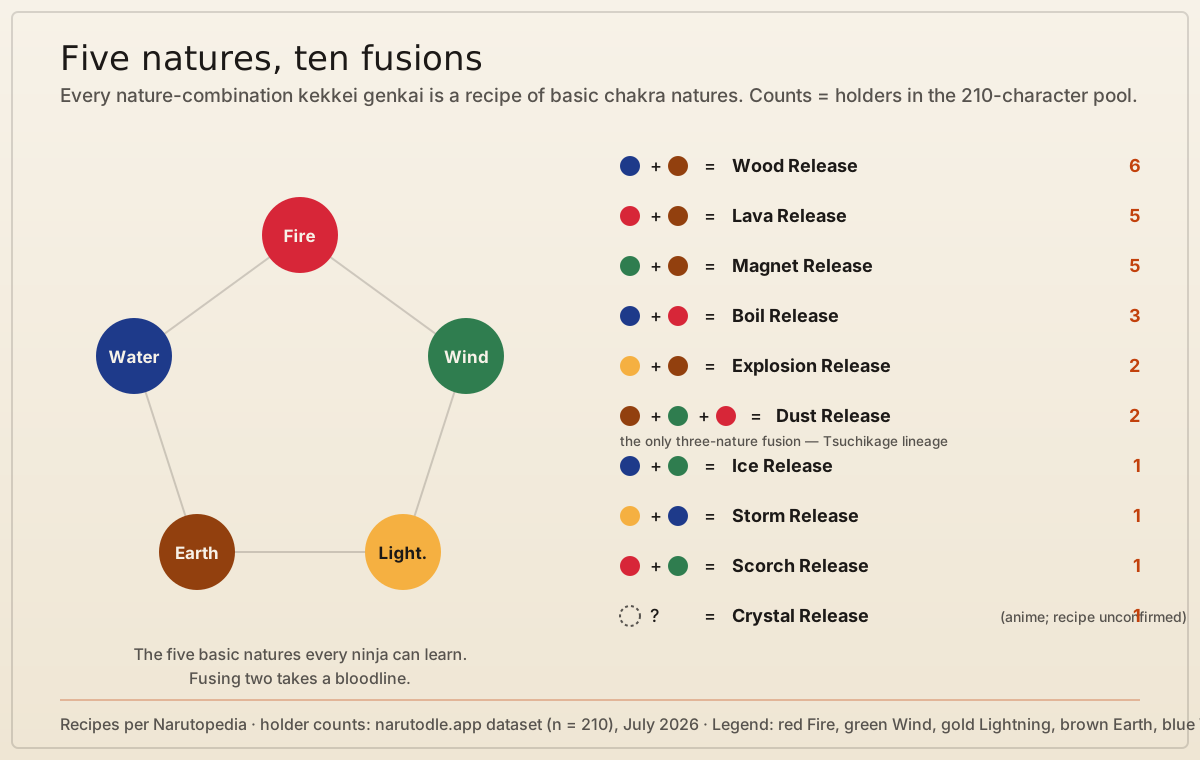
Any jōnin can learn two of the five basic chakra natures. What no amount of training can do is run both through the same technique at the same instant, fusing them into a new element. That simultaneous casting is the bloodline part, and each fusion below is its own kekkei genkai. Note the relationship to the game's separate natures column: a Lava Release user still carries plain Fire and Earth in their nature list, so the fusion and its ingredients show up in different columns of the same guess row.
The heavyweights: Wood, Magnet, Lava
Wood Release (Earth + Water) is the franchise's most storied fusion: Hashirama Senju's living forests could suppress tailed beasts, which is why every later user in the pool is either his cells or his legacy. Magnet Release (Wind + Earth) recurs across Suna and Kumo, from the Kazekage's iron sand to gold dust. Lava Release (Fire + Earth) is the most geographically scattered, appearing in Kiri, Iwa, and among the jinchūriki. Five to six pool users each.
The specialists: Boil, Explosion, Dust
Boil Release (Water + Fire) turns battlefield air into corrosive vapor; the Fifth Mizukage's version melts Susanoo ribs. Explosion Release (commonly given as Earth + Lightning) makes chakra detonate on contact, the engine of both Iwa's Explosion Corps and Deidara's art. Dust Release is the outlier of the whole category: the only three-nature fusion (Earth + Wind + Fire), passed from the Second Tsuchikage to the Third, disintegrating whatever its expanding geometry touches at the molecular level.
The one-of-a-kind releases
Four fusions have exactly one user in the pool, and each is a signature. Ice Release (Water + Wind) belongs to Haku of the scattered Yuki clan, whose thousand needles and demonic mirrors open the entire series' combat history. Storm Release (Lightning + Water) is Darui's guided beams of black lightning. Scorch Release (Fire + Wind) lets Pakura mummify a target by evaporating its water. Crystal Release is the anime's contribution, wielded by Guren; canon never confirms its recipe, which is why the matrix above marks it with a question mark rather than a guess.
Rarity is also the practical reading of this whole section for players. A one-user release is a fingerprint: any yellow or green involving Ice, Storm, Scorch, or Crystal is not a clue, it is the answer's name written in a different alphabet. The five-user releases sit in a middle band where the overlap narrows you to a village-sized shortlist, and the Sharingan line sits at the other extreme, where a hit still leaves a real deduction to run. Rare flags close puzzles; common flags start them.
Category III — Body anomalies
The smallest family, represented in the pool by a single technique: Shikotsumyaku, the Kaguya clan's Dead Bone Pulse. Its wielder manipulates their own skeleton, density, growth, and shape, drawing blades from their forearms and firing fingertip bullets of compressed bone. Kimimaro, the clan's last carrier, fought two future Kage to a standstill while dying of disease, which is the strongest résumé any single-user kekkei genkai owns. The clan itself was wiped out charging Kirigakure's walls for the joy of it, a one-paragraph history that explains both the technique's rarity and its reputation. Canon holds a few more body-type bloodlines beyond the pool (Jūgo's clan transformations among them); this page indexes only what the 210-character dataset compares.
Kekkei genkai vs kekkei tōta vs jinchūriki power
Three kinds of rare power get lumped together in casual conversation, and separating them is half of understanding the system. A kekkei genkai fuses two natures or alters the body, and it is inherited. A kekkei tōta is the same idea one tier up: three natures fused at once. Canon has exactly one, the Dust Release covered above, which is why some taxonomies list it separately; we keep it inside the nature-fusion family with its three-element recipe flagged, because for gameplay purposes it compares like any other bloodline entry.
A jinchūriki's power is neither. Naruto's chakra reserves, Gaara's sand, and Killer B's ink come from a sealed tailed beast, not from DNA, which is why the game tracks jinchūriki status in the attributes column instead of the kekkei genkai column. The distinction trips up experienced fans in the grid constantly: Gaara feels like a bloodline character, yet his kekkei genkai cell compares as Magnet Release specifically, and the sand itself is beast-born. When a guess involving a jinchūriki surprises you, check which column actually produced the signal before pivoting.
The same logic explains a few famous absences from this page. Senjutsu and Sage Mode are learned disciplines, open to anyone with the training and the constitution, so they live in the attributes column. Curse seals are applied, not inherited. And hiden arts like the Nara shadows or the Akimichi expansion, clan-exclusive though they are, remain teachable in principle, which keeps them out of the bloodline column entirely.
Kekkei genkai in Narutodle: the 75% column
In Narutodle Classic, the kekkei genkai column compares full lists with set logic: green when your guess's bloodlines match the answer's exactly, yellow when the lists overlap, red when they share nothing. Because 159 of 210 characters carry no kekkei genkai at all, the column is quiet most days. That silence is exactly what makes it the game's best trap card: the moment a non-none comparison lights up, you are no longer searching 210 characters, you are searching the short rosters printed on this page. A yellow that could only come from the Sharingan line leaves you choosing among Uchiha; a Wood Release overlap narrows to six names.
The strategy guide covers when spending a first guess on a bloodline holder is worth the variance. Or test the theory directly: one of today's answers across Riddle, Quote, and Classic probably carries one of the eighteen limits above.
And if a roster on this page looks wrong to you, it is inspectable by design: every user chip links to a profile with its Narutopedia source, every count regenerates from the live dataset on each build, and corrections reach us at the address on the about page. A reference list that cannot be audited is just an opinion with a table of contents; this one shows its work.
FAQ
- How many kekkei genkai are there in Naruto?
- Canon names more than 20 across the manga, anime, and movies. Within the 210 most-recognizable characters, 18 distinct kekkei genkai appear, held by 51 characters: dōjutsu (7 forms), nature combinations (10 releases), and body anomalies (1).
- What is the rarest kekkei genkai?
- By user count in our dataset, six are one of a kind: Ice Release (Haku), Shikotsumyaku (Kimimaro), Storm Release (Darui), Scorch Release (Pakura), Crystal Release (Guren), and the Tenseigan of Hamura's line.
- Is the Rinnegan a kekkei genkai?
- Yes, and it is regarded as the most exalted of the three great dōjutsu. Only 6 of the 210 dataset characters wield it, including Nagato, Madara, and Sasuke, and it traces back to the Sage of Six Paths' lineage.
- Can a kekkei genkai be copied with the Sharingan?
- No. The Sharingan reproduces ninjutsu, genjutsu, and taijutsu it can perceive, but bloodline limits and clan-secret hiden techniques are genetically bound and cannot be copied by observation.
- Which clans have kekkei genkai?
- The clearest mappings are Uchiha (the Sharingan line), Hyūga (Byakugan), Hashirama of the Senju (Wood Release), Kaguya (Shikotsumyaku), and Yuki (Ice Release). Several releases, such as Magnet and Lava, recur across villages rather than belonging to one clan.